

Latest News
Exhibitors List

Digi Hotel Stage 2025

The event that changed the rules of hospitality

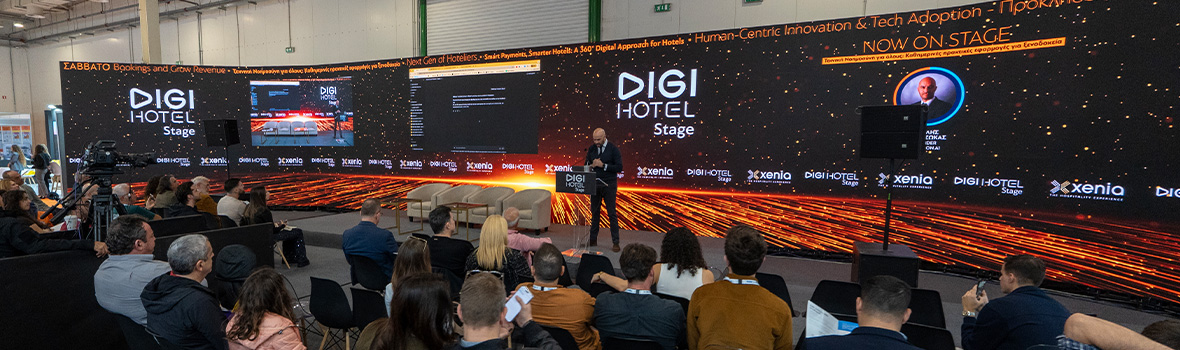
The Digi Hotel Stage at HALL 1 became a reference point for technology and innovation in the hospitality sector. Specialized digital marketing professionals, hotel executives, and representatives of leading companies presented the latest developments and practical applications that transformed the guest experience.

AI and Digital Strategy: The New Face of Hospitality

The Digi Hotel Stage at HALL 1 of Xenia 2025 opened this year’s event with a dense program that showcased every aspect of the digital transition in modern hospitality. Within the framework of an exhibition that has been established as the most important institution of the Greek tourism industry, the first day brought together top executives, technology company representatives, hoteliers, and digital marketing experts, who presented new trends, practical applications of artificial intelligence, and the demands of the new traveling audience. 

The first thematic presentation of the day, titled “When Crisis Meets Tourism” by Loguers, was moderated by journalist Haris Digrintakis (Eleftheros Typos, Alpha989, Director of Tourismtoday.gr). Speakers Markos Georgiou, Managing Director of Loguers, Konnie Metaxa, Artist & Entrepreneur (Hospitality Collaborator), and Sia Kouli, CEO Executive Assistant of Santo Mangata Boutique Hotel in Santorini, discussed how crises affecting tourism can become a starting point for renewal through digital strategy, flexibility, and innovation. Their analysis highlighted the need for dynamic, immediately applicable practices that shield the hotel industry against uncertainties. 

The next session was introduced by journalist Vicky Vamiedaki, who then moderated the panel “Not Science Fiction: How AI is changing the before, during, after travel experience.” Speakers Natasa Karatza, Group Managing Director of Eurotel Group, Lambros Lamprianakis, General Manager of HIT Hospitality, and Alkis Rouggeris, Commercial Director of Epsilon Hospitality, presented concrete examples of AI integration in hotel operations. The discussion emphasized how AI influences accommodation search, the guest experience during the stay, and the relationship between visitor and hotel after check-out, confirming that personalized real-time service has become the new standard. 

This was followed by the presentation “AI-Driven Guest Personalization & Recommendation Engines” by Charalambos Kourtzis, CEO of Exclusivi, who explained how recommendation engines create dynamic guest experiences by drawing on behavioral data and preferences. Next, George Karathanasis, Co-Founder and CCO of Hotellisense, in his talk “How Guest Data Helps You Predict Bookings and Grow Revenue,” analyzed how guest data can be used to forecast bookings, increase direct reservations, and strengthen a hotel’s commercial strategy. 

The day continued with the practical workshop “Artificial Intelligence for All: Everyday Practical Applications for Hotels” by Vasilis Bartzokas, Founder of nospoon.ai. This session was particularly valuable for professionals, as it focused on immediately applicable AI tools such as automated workflows, smart responses to guest inquiries, content management, and operational optimization. 

The discussion about the future of the industry culminated in the panel “Next Gen of Hoteliers,” moderated by journalist Christina Kousouni from Naftemporiki TV. Speakers Evita Chrysochoidi, Member of the Board and Lawyer at Avra Beach Hotel in Rhodes, Efrosyni Lytra, Hotelier at Tharroe Of Mykonos Hotel, and Sotiris Kopatsaris, Managing Director of Carpe Diem Santorini – Future Hotels, spoke about the new generation of professionals who are taking an increasingly active role in hotel management. They emphasized the importance of sustainability, technological flexibility, and the creation of a more modern work culture. 

In the session “Smart Payments, Smarter Hotels: A 360° Digital Approach for Hotels,” Thodoris Mouroutis, Group Indirect Sales Director of viva.com, presented the new possibilities of digital payments and how they enhance both operations and guest experience with faster, safer, and seamless transactions. 

Later, Ioannis Bouzouris, Chief Commercial Officer of MANDYNAMIC, delivered the talk “Human-Centric Innovation & Tech Adoption – Challenges and Prospects,” focusing on the importance of technology that remains human-oriented. 

The first day’s program concluded with the presentation “What Kind of AI Training and Which Skills Do Tourism Employees Need” by Magda Peistikou, PR & Events Training Manager of INSETE. She analyzed the new skills required in the era of artificial intelligence, stressing that employee training and continuous development form the foundation for the smooth transition of the industry into the digital future. 

Digital Marketing, AI and Sustainability 

The second day of Digi Hotel, held within the framework of the XENIA 2025 exhibition, unfolded with undiminished interest and high participation from hospitality, digital marketing, and technology professionals, confirming that the industry is in a period of intense digital transformation. 

The day opened with journalist Viki Vamiedaki, who emphasized that this year’s XENIA finds hospitality businesses facing major changes: artificial intelligence, algorithms, the strong presence of OTAs, and Google’s dominance now decisively influence the visitor’s journey and decision-making process. 

A dynamic panel on the latest trends in digital marketing followed, moderated by Apostolis Aivalis, CEO of KNOWCRUNCH. The discussion featured Anna Bakouli, Digital Marketer & AI Optimization Engineer at Web in Tourism, Alexandros Filiopoulos, Instructor at IEK DELTA, and Michalis Ikoutas, Managing Partner at Three Sixty Marketing. They showcased how technology, artificial intelligence, and modern professional training are shaping the new landscape of hotel marketing. The panel offered a comprehensive view of changes both in tools and strategies, with practical examples and suggestions on how businesses can strengthen their digital presence. 

The flow of the day continued with a presentation by Markos Georgiou, Managing Director of Loguers, who analyzed in depth the relationship between algorithms, OTAs, and Google, examining who ultimately reaches the customer first. His analysis highlighted the importance of a strategic multichannel presence and how proper management of promotional tools can reduce dependence on third-party platforms and increase direct bookings. 

In the same spirit, Savvas Oikonomidis, Performance Marketing Specialist at Mind the Ad, presented ways to leverage customer data and loyalty programs in a GDPR-compliant manner. His talk focused on the practical application of customer insights, showing how segmentation, personalization, and effective use of loyalty schemes can strengthen visitor relationships and build genuine brand loyalty for hotels. 

Maria Nikolikou, SEO & AI Optimization Analyst at Nelios, presented how SEO is being transformed in the age of artificial intelligence. With searches evolving into conversational processes and algorithms prioritizing useful, authentic, and flexible content, hotels are called to rethink their strategies and invest in content that truly addresses travelers’ needs. 

Particular resonance was found in the workshop by Tina Michailidou, Founder of GR8 Communications, who demonstrated how storytelling and short video reels can dramatically enhance the effectiveness of hotel digital marketing. With practical tips and examples, she showed that authenticity and emotional engagement are key elements for content that not only captures attention but also drives bookings. 

Next, Vasilis Kallaras, CEO of Advisable, analyzed the role of short-form video and social commerce, showing how platforms like TikTok are becoming powerful tools for direct bookings. Giannis Koutsopoulos, CEO & Co-Founder of Abouthotelier, followed with a detailed approach to measuring the real success of a digital campaign, emphasizing metrics that truly matter for the hospitality sector, such as conversions, revenue, and cost per booking. 

The focus then shifted to sustainability marketing, in a panel moderated by journalist Viki Tryfona of Power Game. Artemis Tsourlaki, CEO of Theartemis Palace in Rethymno, and Georgia Kontiza, Managing Director of Koukoumi Hotel in Mykonos, discussed how ecological awareness and user-generated content can create real social impact and strengthen a hotel’s brand. The discussion highlighted that authentic sustainability is not only an ethical choice but also a powerful differentiation tool with commercial benefits. 

The day concluded with a panel dedicated to new technologies shaping the future of hospitality, moderated by Katerina Saridaki, Director of CapsuleT Accelerator, who presented the teams distinguished in the 7th cycle of the program. The discussion featured Grigoris Floutsakos, Co-Founder of SmartInn.ai – AI, and Kyriakos Tsitouridis, Co-Founder of Wastecloud – Waste management platform. The two teams showcased solutions for more efficient, smart, and sustainable hotel operations: from AI systems that automate communication and functions to platforms that optimize resource and waste management, offering a clear picture of how innovation translates into practical benefits for both entrepreneurs and guests.

The Future of Hospitality Is Digital, Strategic, and Flexible 

The third and final day of Digi Hotel at the Xenia exhibition concluded a three-day event full of technological breakthroughs, practical solutions, and strategies for a rapidly evolving industry. The day began with the panel “Hotel Vision & Financing Solutions,” which presented a new, holistic approach to how hoteliers can plan and implement their investments. 

This is a comprehensive ecosystem of collaboration between three specialized entities joining forces so that every hotelier or investor now has a one-stop shop to design, finance, and execute their investment. This philosophy was presented by Ioannis Kyritsis, Founder and CEO of Axia Hospitality; Angelos Karakerezis, Head of External Networks and Alternative Channels and Deputy General Manager of Eurobank; and Vasileios Zymnis, Director of Development Programs at Revival Consulting Services S.A. 

The three entities introduced this new ecosystem as a unified platform for evaluation, financing, studies, and implementation, highlighting the importance of the Recovery and Resilience Fund as a unique opportunity for the digital and energy transformation of hotels. The discussion showcased the transition to a new investment model where hoteliers now have access to specialized services with clear structure, guidance, and reduced risk. 

The first major panel, on the latest trends in online sales, was moderated by journalist Viki Vamiedaki, with participants Nikos Tsistoulis, Co-founder of Hotellab; Alexandra Kovlakidou, Business Development Manager Greece at Exely; Thomas Papachristou, Managing Director of Hotelierpro; and Thomas Poulios, Founder of HotelAvailabilities. 

The discussion highlighted the shift from traditional sales management to a more holistic digital performance approach, the rise of automation, the importance of proper channel management, and above all, the use of data as a decision-making guide. There was extensive reference to conversion, reporting tools, and practices to boost direct bookings, with the audience actively engaging with questions. 

In his talk titled “The Death of SEO?: How Independent Hotels Can Win in the Age of AI Search?”, Adam Hamadache, CEO of Formula Digital, posed the question now troubling the entire industry. With the rapid rise of AI-driven search—from semantic search to generative answers—the classic SEO strategy is transforming. He emphasized that SEO is not dying but evolving, and old methods are no longer sufficient. 

Next, Vasileios Riavoglou, Chief Growth Officer at Hotelinsider HBIS, presented how artificial intelligence can make dynamic pricing truly effective. With references to real-time competitive data, predictive analytics, and automated price adjustments, his talk was among the most practical of the day, clearly showing how technology directly boosts RevPAR. 

Alexandros Damigos, CEO and Founder of RateParity, then explained how traffic converts into bookings. He stressed common mistakes that hurt conversion—from site speed to pricing parity—and emphasized that traffic without a conversion strategy remains merely a cost for the hotel. 

Maria Sarri, Head of Sales at webhotelier | primalres, analyzed the value of proper distribution strategy and channel management. She highlighted the ideal channel mix, the right OTA-to-direct ratio, and how hoteliers can maximize profitability through targeted actions and better data analysis. 

At the workshop titled “Trapped in the Algorithm: OTA Practices to Reduce Direct Bookings,” Marios Kounelis, Chief Sales Officer at webhotelier | primalres; Vicky Dorzioti, Executive Director at Axia Hospitality; and Dimitris Serifis, CEO of Nelios, presented in detail the strategies OTAs use to influence direct bookings. They discussed “hidden” ranking mechanisms, practices that steer visitors toward specific hotels, and ways hoteliers can regain control and visibility. This was one of the liveliest discussions of the three-day event, with the audience sharing timely examples and personal experiences. 

Evangelia Karaliolou, Sales Manager at Roomismo, showcased how smart rooms are evolving into true selling points. Today’s traveler, she noted, seeks frictionless experiences, and in-room technology now directly influences booking decisions. Then, Athanasios Piliounis, Co-Founder and CEO of RADEFY, spoke about the shift from smart check-in to holistic smart hospitality. He described how mobile-first journeys, automation, and services tailored to traveler behavior are changing both the guest experience and hoteliers’ requirements. Manolis Papadakis, Managing Director of Mikos Greece, shared real case studies of digital transformation, presenting data before and after adopting new technologies, with tangible examples of modernization leading to measurable results. 

The day—and Digi Hotel overall—closed with the major STAMA panel on the digital needs of property managers in short-term rentals. Moderated by Stathis Karopoulos, Director of STAMA Greece, and featuring Stelios Christakis, Board Member of STAMA and CEO of Tourmie; Theoharis Michailidis, Secretary of STAMA and CEO of Villa Rentals; Kiamou Konstantinos, Vice President of STAMA and CEO of UP STREET; and Vasilis Argyarakis, Treasurer of STAMA and CEO of See Greece, the panel highlighted the challenges of a sector now playing a leading role in Greece’s tourism ecosystem. The discussion covered automation tools, managing large property portfolios, the role of review scores, and the need for a professional digital environment. 

Digi Hotel concluded with energy, knowledge, and a clear message: the hotelier of 2026 must be not only an entrepreneur but also digitally mature, flexible, and strategic. 

Under The Auspicies
Media Partners